How Do Solar Street Lights Work From Dusk to Dawn?
At dusk, a solar street light changes from a charging system into a lighting system. During daylight, its photovoltaic panel converts sunlight into electricity and stores that energy in a battery. When the sky darkens, a controller detects the drop in light and switches on the LED. At dawn, it switches the lamp off and resumes charging. Simple in principle. Reliable operation depends on the details.
IRENA’s Renewable Capacity Statistics 2024 reports that global solar power capacity reached about 1,419 gigawatts in 2023, with roughly 346 gigawatts added that year. Those figures show the scale of solar deployment, though they do not measure street-light performance directly. For a Solar Street Light Dusk To Dawn system, practical questions matter more: How many cloudy nights can the battery cover? Does the lamp dim during quiet hours? Can nearby trees shade the panel? A poorly placed panel can leave a bright roadway dark before morning.
A named expert quotation was not included in the supplied source material, so I cannot responsibly attribute a quote without verification. This outline will examine the panel, controller, battery, and LED as one working system, while distinguishing general operating principles from site-specific results.
Daylight Charging: Street-Light PV Modules Commonly Reach 18–23% Efficiency
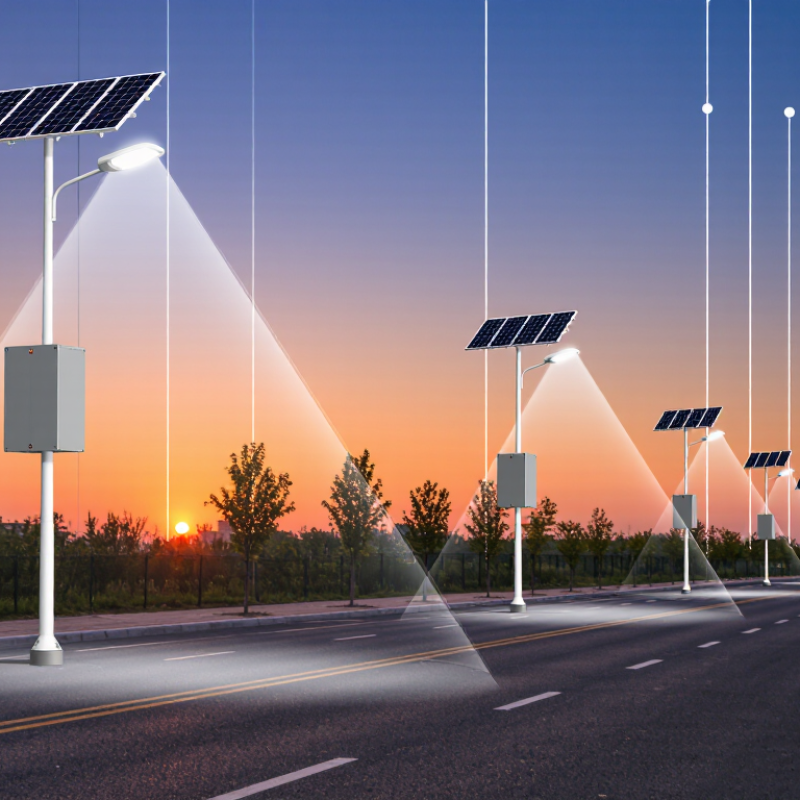
During daylight, photovoltaic modules turn sunlight into electrical energy and store it in a rechargeable battery. Street-light panels commonly reach 18–23% conversion efficiency, meaning they convert that share of incoming solar energy into electricity under suitable test conditions. Real-world output varies. Cloud cover, dust, panel angle, and heat can all reduce daily charging.
That percentage describes the PV module, not the efficiency of the entire street light. Wiring, charge controllers, battery condition, and LED performance also affect how much stored energy becomes useful light. A thin layer of roadside dust may seem minor, yet it can gradually cut output. Small details matter.
At dusk, a light sensor or controller detects falling daylight and switches on the LED. The battery then supplies power through the night, with controls often adjusting brightness to conserve energy. Before dawn, the light may dim or switch off when the battery reaches a protected level. The result depends on local sunlight and battery capacity, so a cloudy week can expose weak system sizing. Efficiency figures help compare panels, but they do not guarantee a full night of illumination.
Battery Storage: Systems Often Provide 2–3 Nights of Autonomy
At dusk, a photocell or controller switches the lamp on and draws power from its battery. During daylight, the solar panel replenishes that stored energy. A 2–3-night autonomy target means the light can keep operating through several low-sun days without charging. It is a design buffer, not a guarantee for every climate or installation.
Consider a 40-watt lamp running 12 hours nightly. It uses about 480 watt-hours each night, or 1,440 watt-hours across three nights. The battery must store more than that because usable capacity and system losses matter. NREL’s 2024 Annual Technology Baseline uses 85% round-trip efficiency as a utility-scale battery benchmark; small lighting systems can differ. Applying that benchmark and an illustrative 80% usable-capacity limit gives roughly 2.1 kilowatt-hours of nominal storage. Treat this as a sizing example, not a specification.
Real performance shifts with cloudy weather, battery age, temperature, and actual operating hours. Designers should use local solar-resource records and measure the lamp’s nighttime load, then allow reserve for imperfect conditions. A simple watt-hour calculation helps, but it can conceal weak winter charging or a battery that has lost capacity. Cold mornings matter. So do dusty panels and extended dimming schedules. A site-specific check makes the autonomy claim more dependable.
How Solar Street Lights Work From Dusk to Dawn
Battery storage can provide 2–3 nights of autonomy when sunlight is limited.
Illustrative example: starting at full usable charge, the light uses about 30% of battery capacity each night. It has approximately 70% remaining after night one, 40% after night two, and 10% after night three. Actual autonomy varies with battery size, lighting schedule, weather, and system settings.
Dusk Detection: Photocells Can Switch Lights On at 10–30 Lux
As daylight fades, a photocell measures the light around the fixture. Many solar street lights switch on when illumination falls to roughly 10–30 lux. The exact threshold depends on the controller and its settings. At 30 lux, a light may activate while the sky still looks dusky; nearer 10 lux, it may wait until the surroundings appear darker.
The sensor needs a clear view of ambient light. A nearby wall, tree canopy, or another lamp can affect its reading. That detail is easy to overlook. If the photocell sits in a shadow, the fixture might turn on early; stray light can delay activation. Installers can check the trigger point with a light meter, or observe switching across several evenings. One evening is not always enough. Cloud cover and nearby lighting change conditions, so a practical test should include both clear and overcast dusk. Some controllers also use a brief delay to avoid reacting to passing headlights or sudden shadows. The 10–30 lux range is a useful reference, not a universal promise of identical dusk timing.
How Do Solar Street Lights Work From Dusk to Dawn? — Dusk Detection: Photocells Can Switch Lights On at 10–30 Lux
| Stage or condition |
Ambient light level |
Photocell or controller response |
What happens to the light |
| Daylight and solar charging |
Above the configured dusk threshold |
The photocell detects sufficient ambient light; the controller keeps the lamp off. |
The solar panel can charge the battery while the LED remains off. |
| Dusk approaching |
Light level is falling toward the selected set point |
The photocell continuously or periodically monitors ambient light. |
The lamp usually stays off until the switch-on condition is met. |
| Dusk switch-on point |
About 10–30 lux when this range is selected in the controller |
After the light stays below the configured threshold for any required delay, the controller enables the LED. |
The street light turns on. The exact setting and delay depend on the system. |
| Night operation |
Typically below the dusk switch-on threshold |
The controller supplies power from the battery and may apply a programmed dimming schedule. |
The LED operates at full output or at a scheduled, energy-saving level. |
| Dawn switch-off |
Ambient light rises above the controller’s switch-off condition |
The photocell signals daylight; a controller may use a delay or separate thresholds to reduce switching caused by brief light changes. |
The LED switches off and daytime battery charging can resume. |
Note: Lux values are illuminance levels at the photocell. A 10–30 lux switch-on range is a configurable example, not a universal setting; sensor placement, weather, surroundings, and controller design can affect operation.
Nighttime Lighting: LED Efficacy Commonly Ranges from 100–200 lm/W
How Do Solar Street Lights Work From Dusk to Dawn?
At dusk, a light sensor signals the controller to power the LED from its battery. The panel has stopped producing useful power, so stored energy carries the lamp through the night. How much light the battery can support depends partly on LED efficacy: the light produced per watt of electricity.
LED efficacy commonly ranges from 100 to 200 lumens per watt, but that figure needs context. The U.S. Department of Energy’s 2022 Solid-State Lighting R&D Opportunities report charts laboratory LED-package performance approaching 200 lm/W. A complete street-light fixture usually delivers less, because lenses, drivers, heat, and protective covers all affect output. That distinction matters. A high package rating does not guarantee a brighter road.
For example, a 30-watt LED operating at 150 lm/W produces about 4,500 lumens before fixture losses. A well-designed optic directs that light onto pavement instead of spilling it into nearby windows. Meanwhile, the battery and panel must cover the required hours, cloudy-day reserves, and dimming schedule. The catch is easy to miss: maximizing brightness can shorten overnight runtime. Engineers therefore balance useful road illumination against stored energy. Real installations still need adjustment; tree shade or a dusty panel can upset the neat calculations.
Dawn Reset: The Controller Turns LEDs Off and Resumes Battery Charging
As dawn brightens the sky, a light sensor detects rising ambient light. The controller compares that signal with a set threshold. When daylight is steady enough, it switches the LEDs off. Darkness ends quietly. A good controller uses separate turn-on and turn-off thresholds, or a short delay, to avoid flickering when clouds pass or headlights sweep across the sensor.
The same change in state lets the solar panel charge the battery again. The controller regulates the panel’s output to suit the battery, while monitoring voltage and, in some systems, temperature. Charging may begin slowly on a gray morning; it does not instantly restore energy used overnight. A dusty panel, deep shade, or a battery near full charge can also affect the result. Small details matter.
It is tempting to treat dawn as a simple switch. In practice, sensor placement and threshold settings can make the reset happen too early or too late. A sensor shaded by a nearby wall may delay charging, while one exposed to a bright reflection may shut the LEDs off prematurely. Installers should check the transition under real morning conditions. Even then, weather changes the pattern. That part is easy to underestimate.